Summary
A company that buys renewable energy certificates in several countries has three tasks to solve: coordinate purchasing across all its markets, redeem each certificate in the name of the entity that consumed the energy, and keep the evidence for each year. A strategy organizes these three tasks before the first quote. It is built in five steps:
- Define the perimeter.
- Calculate residual consumption.
- Set the purchasing criteria.
- Centralize purchasing and assign redemption by entity.
- Archive the evidence by year.
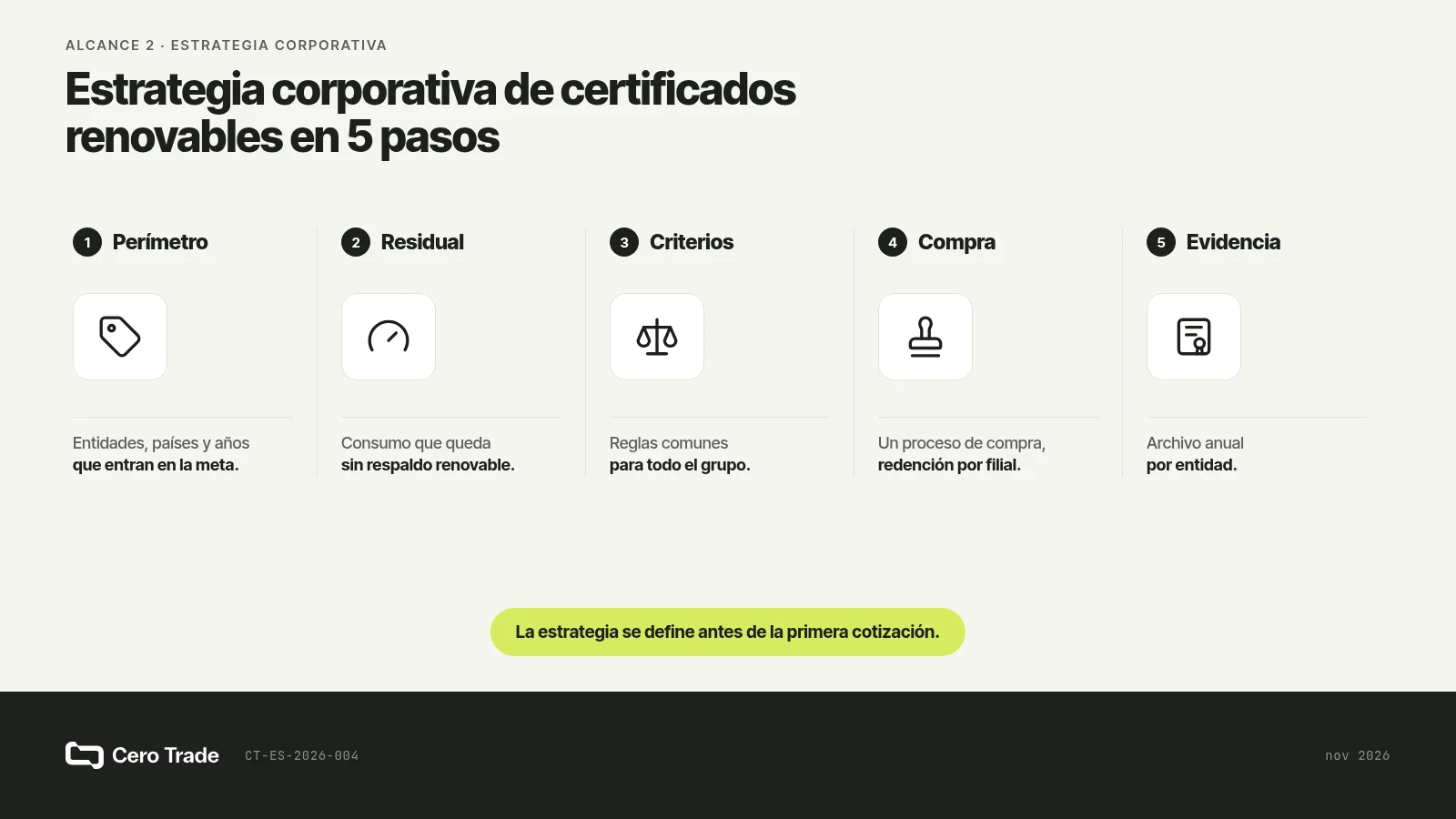
The strategy is defined before the first quote: perimeter, residual, criteria, purchasing with redemption by subsidiary, and annual evidence.
Why the strategy comes before the quote
In our conversations with groups that operate in several countries, one pattern repeats. Before asking about price, they ask how to coordinate purchasing across their subsidiaries. Each country has its own suppliers, currency, legal requirements, and registry. When each subsidiary buys on its own, the group ends up with different criteria, different contracts, and evidence spread across several people.
One case illustrates the point. A group operating in nine countries in the region reported 92% renewable electricity in its latest report. Its pending task was to cover the remaining share, subsidiary by subsidiary, with a method it could repeat every year. That method is the strategy.
Step 1. Define the perimeter
The perimeter is the list of entities included in the target. It is built as a table with one row per legal entity and these columns:
| Country | Legal entity | Reporting year | Customer type (free-market or regulated) | Electricity consumption (MWh) | Standard or target it reports to |
|---|
The customer type column defines how the residual is calculated in the next step. The last column states who each entity reports to: the group report, RE100, SBTi, or a local disclosure. This table is the basis for the following steps, because each certificate is bought and redeemed for a specific row.
Step 2. Calculate residual consumption
Residual consumption is the electricity that still has no renewable backing. Certificates cover that residual. The calculation depends on each entity's type of supply:
- Free-market customer. Negotiates supply directly with a generator, usually through a power purchase agreement (PPA). Some PPAs include the I-RECs for the energy delivered and others include only the energy. Ask the generator what the contract includes. If it includes the certificates, that consumption is already backed; if it includes only the energy, that consumption is added to the residual.
- Regulated customer. Buys electricity from the distribution company and consumes the grid mix. To report that consumption as renewable, it needs to buy I-RECs separately from the energy, also known as unbundled certificates.
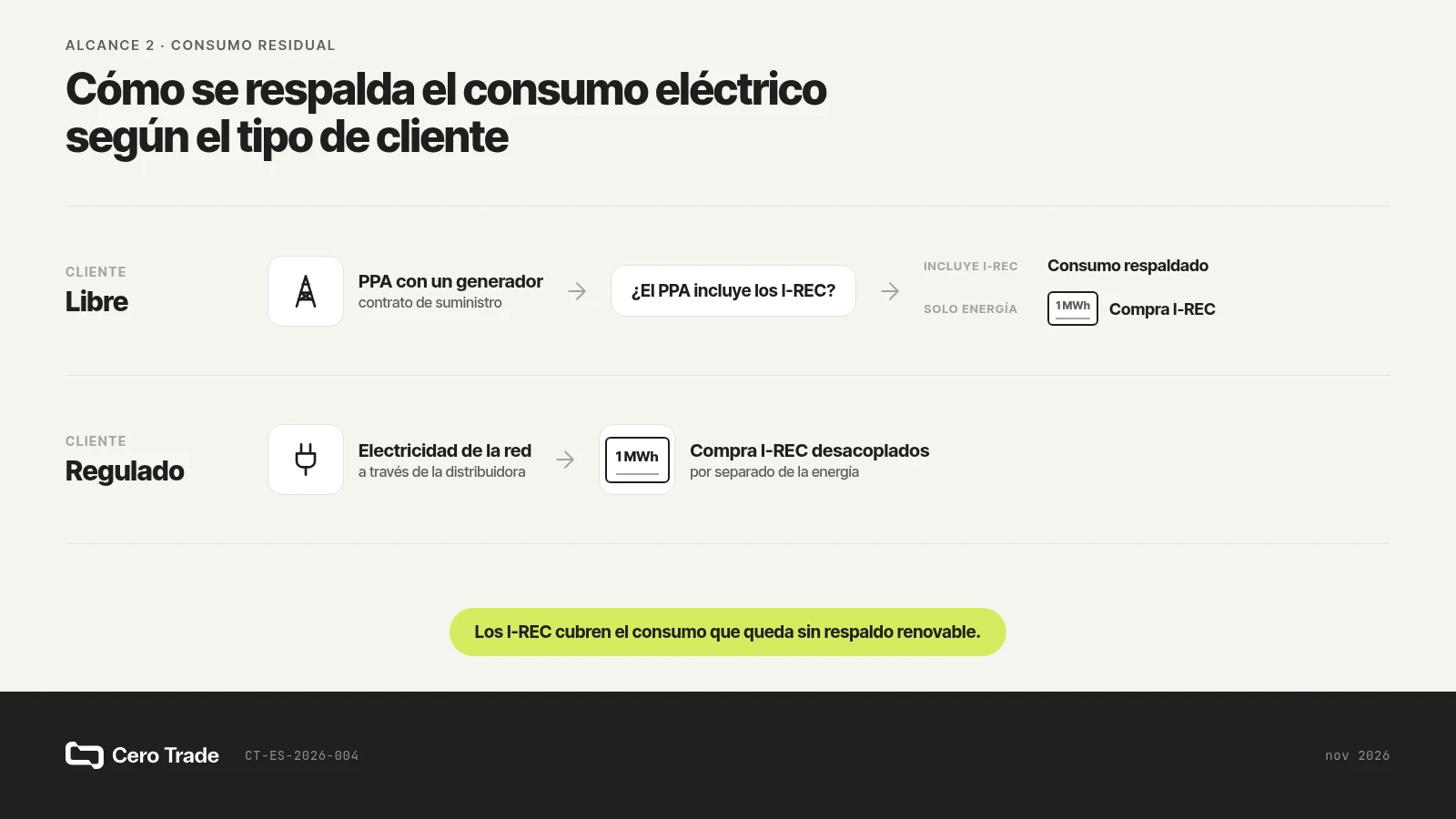
For a free-market customer, the PPA may include the I-RECs or only the energy; a regulated customer buys unbundled I-RECs to report its consumption as renewable. A single group can have entities of both types, which is why the calculation is done row by row. On-site renewable generation, such as rooftop panels, is also subtracted from consumption before calculating the residual. The full sequence for reducing electricity Scope 2 is in How to bring electricity Scope 2 down.
The accuracy of the calculation depends on the available data. When there is metering by entity, the residual is expressed in MWh. When only the group's consolidated percentage exists, the residual is recorded as a percentage until metering for each subsidiary is available.
Step 3. Set the purchasing criteria
Criteria are defined once for the whole group and applied in every country:
- Country of origin of the certificate, according to what each entity's reporting standard requires.
- Generation year (vintage): the same year as the consumption, or a range allowed by the standard.
- Technology, if the target or internal policy specifies it.
- Redemption service: whether the supplier redeems the certificates or the company does it in the registry.
With criteria set in advance, offers from different countries can be compared on equal terms.
Step 4. Centralize purchasing and assign redemption by entity
Purchasing is coordinated through a single process for the whole group, with common criteria, timelines, and terms. Redemption, on the other hand, is done by entity: the beneficiary of each certificate is the legal entity of the subsidiary that consumed the energy, and the location states the name of the consumption site and its full address.
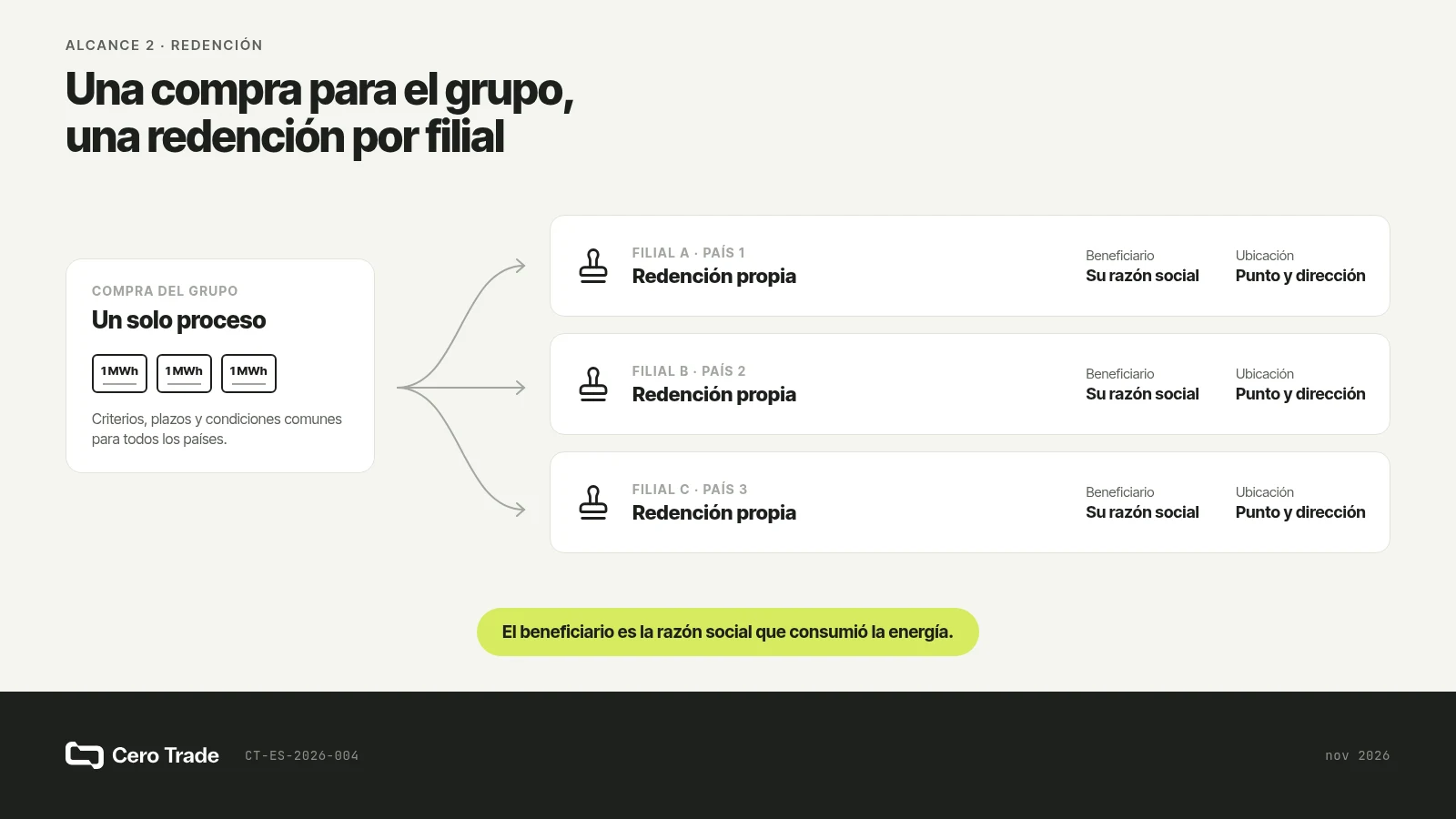
One purchasing process for the group; each subsidiary receives its own redemption, with its legal entity as the beneficiary. This assignment requires care because redemption is irreversible. A certificate redeemed in the name of another entity no longer serves the subsidiary that needed it. It is also advisable to plan for each legal entity to approve and pay its share separately, with its own purchase order.
Step 5. Archive the evidence by year
For each entity and each year, the archive brings together:
- the redemption statement issued by the registry;
- the amount of MWh and the consumption period covered;
- the purchase contract and invoice.
This archive is what gets presented in an audit or in the verification of the report. Keeping the same format year after year makes periods comparable and shortens the work of the next cycle.
Synthesis
| Step | Question it answers | Output |
|---|---|---|
| 1. Perimeter | Which entities are part of the target? | Table by country, legal entity, customer type, and year |
| 2. Residual | How much consumption remains to be covered? | MWh, or percentage, by entity |
| 3. Criteria | Which certificates qualify? | Common rules for the whole group |
| 4. Purchasing and redemption | How is it bought and in whose name? | One purchasing process, redemption by subsidiary |
| 5. Evidence | How is it demonstrated? | Annual archive by entity |
If your company operates in several countries or through several legal entities, request a diagnostic session: we will review the perimeter and the residual consumption of each entity with you.